Responsible Officers: Fit and Proper assessments and Applicant Interviews
September 2026
Responsible Officer Applications – Considerations the IA Must Take into Account
Every licensed insurance broker company and licensed insurance agency needs to appoint at least one responsible officer, who must be approved by the IA. This is a pre-requisite for the licence of the broker company or agency to be granted and renewed (and neither suspended nor revoked between renewals).
For the IA to approve a candidate as responsible officer, we must be satisfied that:
- The candidate is (or will be) licensed as a technical representative, in the lines of business carried on by the broker company or agency;
- The candidate is fit and proper to discharge his or her responsibilities as a responsible officer of the broker company or agency; and
- The candidate has sufficient authority from the broker company or agency, and will be provided with sufficient resources and support, to discharge the responsibilities as a responsible officer.
There are three important points to note from this:
First, the IA’s assessment focuses on the fitness and properness of the candidate to perform the responsibilities of a responsible officer. In addition to integrity and the requisite technical knowledge and experience in the relevant lines of business of the entity, the assessment also considers whether the candidate has knowledge and capabilities to discharge the duties assigned to a responsible officer under sections 91 (in the case of an insurance agency) and 92 (in the case of a broker company) of the Insurance Ordinance. These sections require a responsible officer to use best endeavours to ensure the business entity establishes and maintains proper controls and procedures for securing compliance with the core conduct requirements in the insurance regulatory regime by both the entity and its technical representatives. In making this determination, then, the IA needs to be satisfied that the candidate (i) has knowledge of the conduct requirements and the regulatory requirements underpinning these, (ii) understands the governance controls and processes required to meet these requirements, and (iii) demonstrates a practical compliance mindset.
Secondly, as the IO makes clear, the fitness and properness of a responsible officer must not be considered by the IA in a vacuum, but in the context of the specific entity to which he or she is to be appointed. As such, the IA must consider the candidate’s capabilities taking account of the specific lines of business the entity will carry on, the size and business model of its operation, the level of authority and resources available, and the track record of the entity in terms of compliance. These factors set the scope of the task that the candidate will be taking on as an RO (if is appointed). They are therefore essential considerations in determining whether the candidate is fit and proper to take on that task.
Thirdly, the IO makes clear that the IA must not approve the application unless it is satisfied of the candidate’s fitness and properness to take on the role. The bar, then, whilst not insurmountable or unreasonable, is necessarily a high one to achieve, given the importance of the responsible officer role.
Interviewing Responsible Officer Candidates
The IA has a set of standard (electronic) application forms for responsible officer applications. However, as stated, the IA is obliged to reject an application unless it is satisfied of the candidate’s fitness and properness to perform the responsibilities of responsible officer for the particular broker company or agency making the application. The information provided on the form may not always be sufficient to reach that level of satisfaction. It may therefore be necessary to hear from the candidate directly — particularly to assess the candidate’s understanding of the responsibilities of the role in the context of the applicant entity — before the IA can approve the application (or at least make a final determination). It is for this reason that the IA may ask the candidate to attend an interview as part of the application process.
The IA does not need to interview candidates in every case. Context, as stated, is important. The application is to serve as a responsible officer of a particular entity. The more complex the role the candidate will be taking on (particularly in terms of conduct risk), the more likely it is that hearing from the candidate directly via an interview will prove necessary, to give the candidate the opportunity to establish his or her fitness and properness.
Generally, responsible officers of insurance broker companies have more regulatory responsibilities to contend with than responsible officers of insurance agencies (this stems from broker companies, being representatives of policyholders and being independent from insurers). In terms of lines of business, life insurance generally has a higher level of regulatory requirements to contend with than general insurance. Further, certain business models come with higher levels of conduct regulatory risk than others. In recent years business models focusing on acquiring customers through referrals from unlicensed persons to purchase life insurance policies, have come with the highest levels of conduct risk..
For these reasons, given the higher level of complexities involved, it is likely that responsible officer candidates for broker companies carrying on life insurance (especially those companies running referral business models) will be asked to attend an interview as part of the application process. But this is not to say that interviews will solely be reserved for such broker companies - it will always depend on the context, because the application must be considered in the specific context of the broker company or agency putting forward the application.
The areas the IA may explore during the interview, will always focus on assessing the candidate’s fitness and properness to discharge the responsibilities of the specific broker company or agency. As such – whilst there is no set list of questions – a candidate can expect the following matters to be covered in the interview:
- Business model and strategy
The IA has to determine whether the candidate is fit and proper to discharge the responsibilities of responsible officer for the particular business entity in question. The business model of the entity, and the regulatory requirements applicable to that model, must therefore form part of that consideration.
During the interview, the IA may seek to gain a deeper understanding of the candidate’s knowledge of the entity’s business model and business strategy, and of how the candidate will establish controls to ensure the business model and strategy are discharged in a way that meets the conduct regulatory requirements. If the business model depends on a referral model, particular focus will be placed on compliance with relevant General Principles and their related Standards and Practices as stipulated in the Code of Conduct, and the expectations on how to meet these requirements (and other regulatory requirements) as set out in the IA’s circulars of 22 May 2024 and 1 September 2025. If the business model involves any of the services covered by the IA’s Practice Note on the application of requirements in the insurance regulatory framework to specific services provided by licensed insurance brokers on investment choices and premium allocations under Investment-Linked Assurance Scheme Policies (“ILAS Policies”) issued on 5 July 2024, discussion will also focus on the requirements stated therein.
- Insurance and management experience of the proposed responsible officer
The interview serves as an opportunity for the proposed responsible officer to demonstrate how his / her previous experience is commensurate with the nature and scale of business of the entity for which he or she is candidate, and the level of responsibilities he or she will be taking on.
The candidate should therefore take the opportunity to demonstrate an adequate knowledge of the regulatory requirements that the entity will need to meet and the type of controls and processes that need to be established to ensure compliance.
- Governance and compliance structure
The responsibilities of a responsible officer (as set out in sections 91 and 92 of the IO) focus on establishing governance controls and processes. As such, in the interview, a candidate can expect to be asked questions about their experience of establishing such governance controls and processes to achieve compliance with the requisite regulatory requirements. This goes to the absolute core of a responsible officer’s responsibilities as set out in the IO.
Takeaways and Summary
- In considering whether a responsible officer is “fit and proper” to take on the role, the IA is obliged to consider the application in the specific context of the broker company or agency for which the candidate is being considered. To give candidates the opportunity to demonstrate their fitness and properness, the IA may seek to interview them, particularly where the task they are taking on has relatively higher conduct risk.
- In general, insurance broker companies have higher conduct risk than insurance agencies because they have more regulatory requirements to contend with. For the same reason, long term business has higher conduct risk than general business. Further specific business models – such as heavily relied on referral business – come with high conduct risk.
- As such, a responsible officer candidate for a broker company carrying on long term business that uses a referral business model, will likely be asked to attend an interview to assist the IA in assessing the candidate’s fitness and properness.
Responsible Officers – Statistics on Tenure
As indicated in the previous paragraphs, in terms of conduct risk, licensed insurance broker companies carrying on life insurance with a referral business model, lead the way. The level of conduct risk is amplified when one considers that the average tenure for responsible officers of broker companies in this segment is the shortest in the market, as the following statistics demonstrate.
Overall Average RO Appointment Duration
The responsible officer (“RO”) role has technically existed under the current regulatory regime only since 23 September 2019. The longest tenure of any RO to date is therefore approximately 7 years (for the purpose of these statistics only, we do not take into account any periods of tenure of “chief executives” under the self-regulatory regime).
The average tenure of active ROs as at 30 June 2026, across all insurance broker companies and insurance agencies, is 3.8 years. The average tenure of RO appointments that ended before 30 June 2026 is 1.6 years. Looking at all RO appointments (whether active or ended) between 23 September 2019 and 30 June 2026, the average tenure is 2.9 years, which suggests a reasonable degree of stability at first glance.
Long Term Business vs General/Travel Business
However, the analysis becomes more telling, once the statistics are segmented by lines of business. A clear dichotomy emerges between, on the one hand, the tenure of RO appointments for broker companies and insurance agencies that only carry on general insurance and travel insurance business, and on the one hand, broker companies and insurance agencies that carry on long term business.
For broker companies and agencies carrying on all lines of business, 34.3% of ROs have served in their position for between 4 to 5 years, with 53.4% of tenures lasting for 3 years or more.
By contrast, if we exclude broker companies and insurance agencies carrying on only general business and travel business, and focus on those carrying on long term business, we find that 51.4% of RO appointments have lasted less than 2 years in duration.
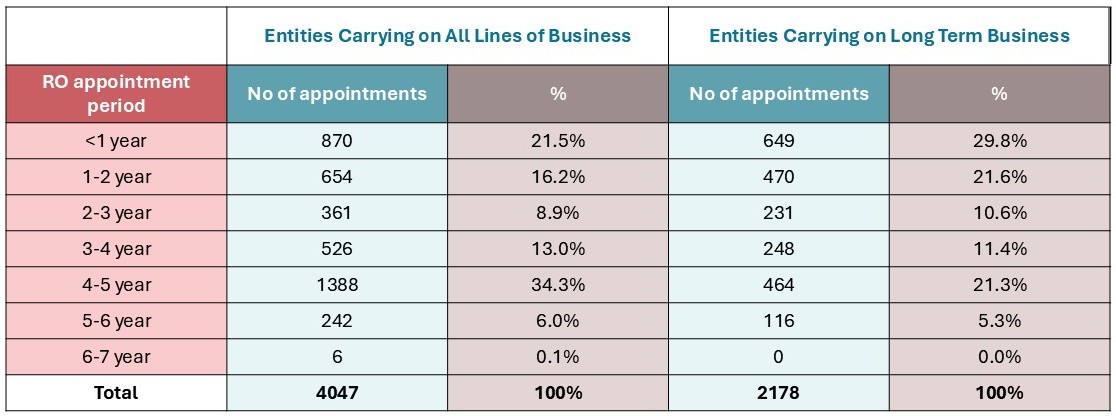
In other words, the turnover of ROs for business entities carrying on long term business (which has relatively higher conduct risk) is higher than for the general business/travel business (which has relatively lower conduct risk).
When it comes to RO appointment tenure, therefore, “long term business” doesn’t mean “long term”!
Agency compared with Broker Company
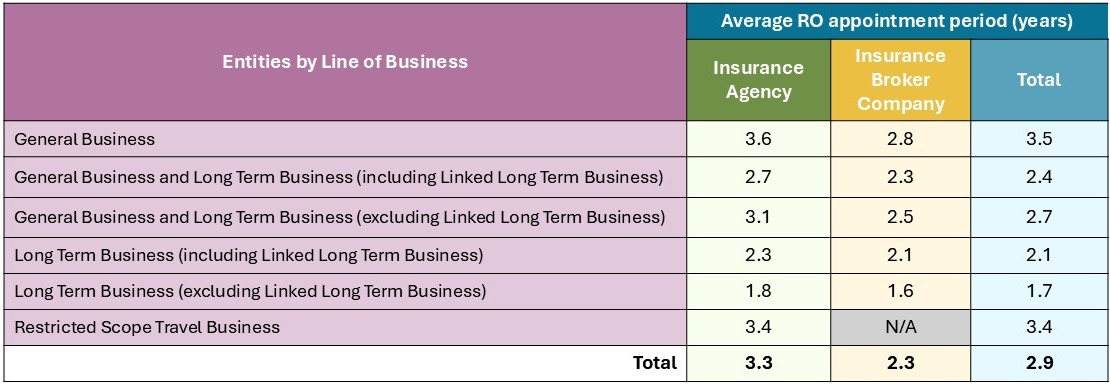
Segmentation of RO tenure data between insurance agencies and insurance broker companies shows that ROs for insurance agencies remain in their positions for an average of 3.3 years, as compared with 2.3 years for insurance broker companies.
This is also telling given that the entity licence (for an agency or a broker company) is generally three-years in duration. On average, an RO for an agency will outlast a single licence period for the agency it serves, whereas this is not the case (on average) for ROs of broker companies.
Number of RO Appointments for Each RO – Low Job-hopping Tendencies
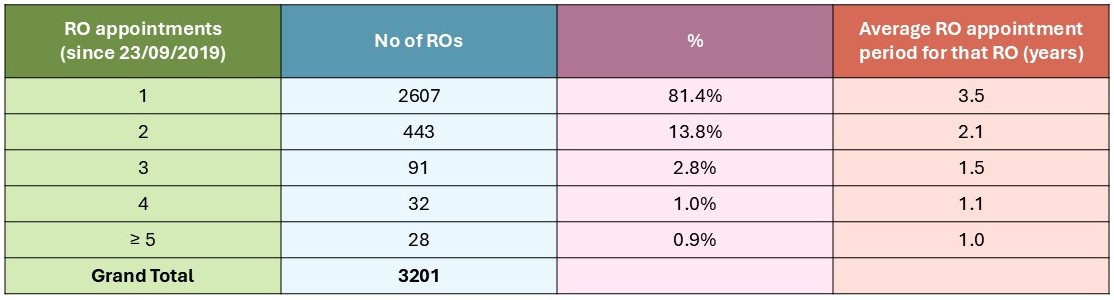
From 23 September 2019 to 30 June 2026, 3,201 individuals have been approved as ROs of insurance broker companies or insurance agencies. The vast majority of ROs (2,607 – 81.4%) have had only a single appointment records. ROs in this segment also have the longest average appointment duration for 3.5 years.
Only 13.8% of ROs have had two appointment records (moving from one licensed entity to another), while less than 5% of ROs have three or more appointment records (moving from one licensed entity to another, then to another). This indicates that frequent job changes are relatively uncommon.
Takeaways
Overall, the average tenure of 3.8 years for current active RO appointments – being longer than the standard licence period of 3 years insurance broker companies and insurance agencies – generally indicates overall stability. However, the tenure reduces for ROs of entities carrying on long term business. ROs of insurance broker companies also generally have a shorter tenure than insurance agencies. Again this indicates why, in assessing fitness and properness, interviews for candidates of insurance broker companies carrying on long term business are more likely.
As a benchmark, the IA considers it healthy where RO appointment duration exceeds 3 years (the tenure of the standard entity licence). Longer tenure contributes to management stability, facilitates effective oversight and supports sound corporate governance and risk management, thereby strengthening policyholder protection.
By contrast, high RO turnover or repeated short-term RO appointments for a particular entity, is an indicator of higher conduct risk (and, potentially, weaker governance and controls and lack of resourcing, authority and support for the RO position). For an entity with such turnover, the IA may consider it important to conduct an interview for any candidate for an RO put forward. Beyond this, it may also be necessary for the IA to conduct supervisory reviews or onsite inspections to assess the effectiveness and adequacy of its management oversight and control environment of the entity in question (a matter of relevance to the entity’s continued fitness and properness).